The question
In the sleep lab, a well-known trick improves memory. While you learn, a sound or smell plays in the background. During deep sleep that night, the same cue is replayed quietly. The cue seems to nudge the brain into replaying, and strengthening, what you learned. This is called targeted memory reactivation (TMR).
Lab TMR, though, needs EEG equipment, a technician, and a separate cue for every item. Could a stripped-down version work in everyday life? We changed three things:
- Hardware: a Samsung Galaxy Watch tracks sleep stages on its own and delivers the cue as a vibration.
- One cue for everything: a single vibration is linked to a whole learning session, not to individual facts.
- Real learning material: a cat documentary, where you don’t know what will be tested, instead of simple word lists.
What we did
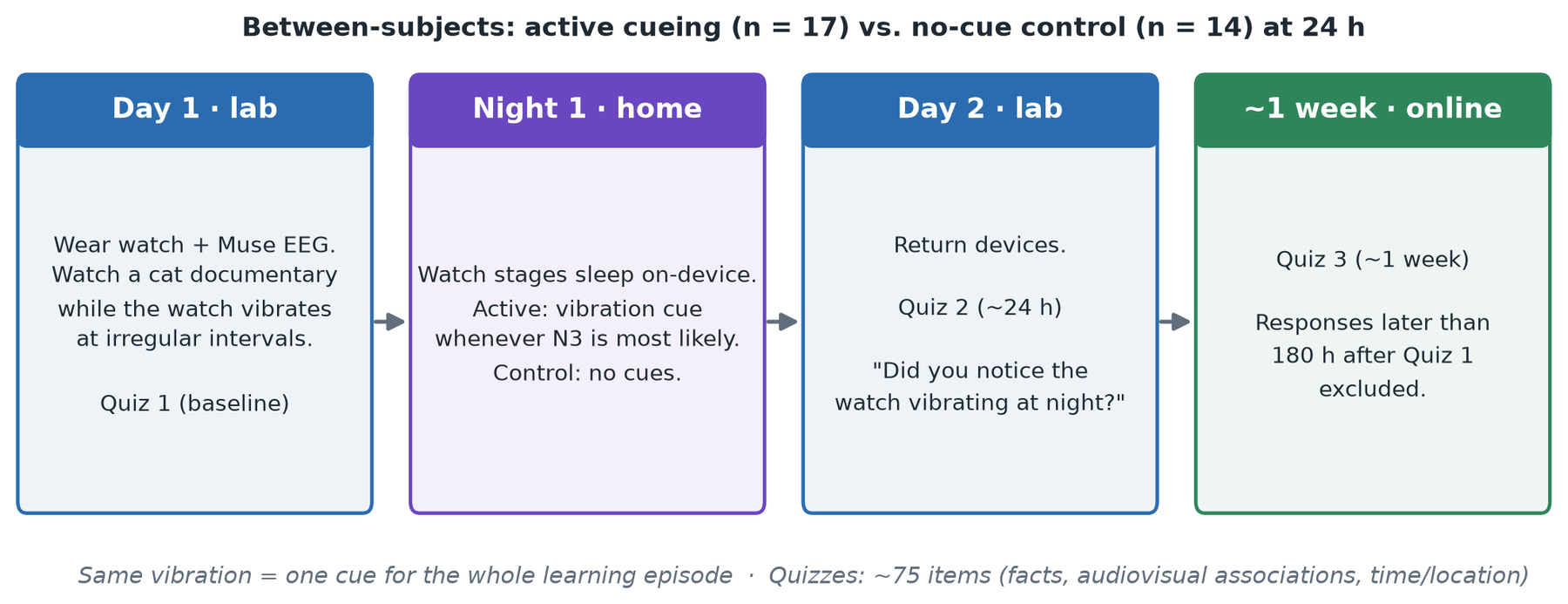
At their first visit, participants were assigned to an active group, which got vibration cues during deep sleep, or a control group, which got none.
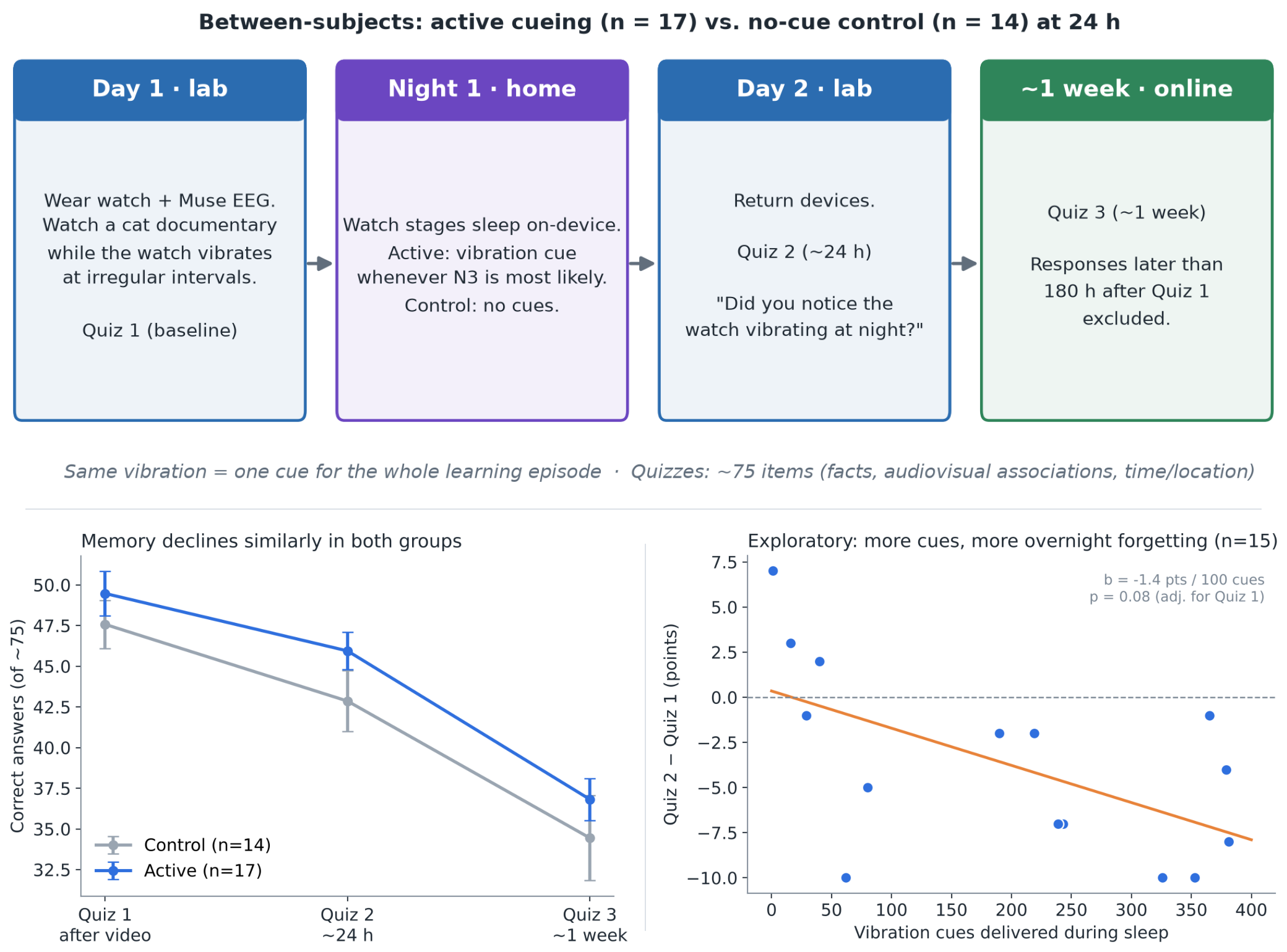
On Day 1, in the lab, participants watched the documentary while the watch vibrated at irregular intervals, then took Quiz 1. That night at home, an app on the watch estimated sleep stage every few seconds and, for the active group, vibrated whenever deep (N3) sleep was the most likely stage. Participants took Quiz 2 about 24 hours after learning and Quiz 3 about a week later. Each quiz had about 75 questions covering facts, sights and sounds, and when or where things happened.
41 people enrolled. 31 could be analyzed at 24 hours (17 active, 14 control), and 20 at one week. We analyzed later scores while controlling for each person’s Quiz 1 score (ANCOVA), which accounts for the fact that people who start high tend to lose more.
What we found
1. No reliable memory benefit
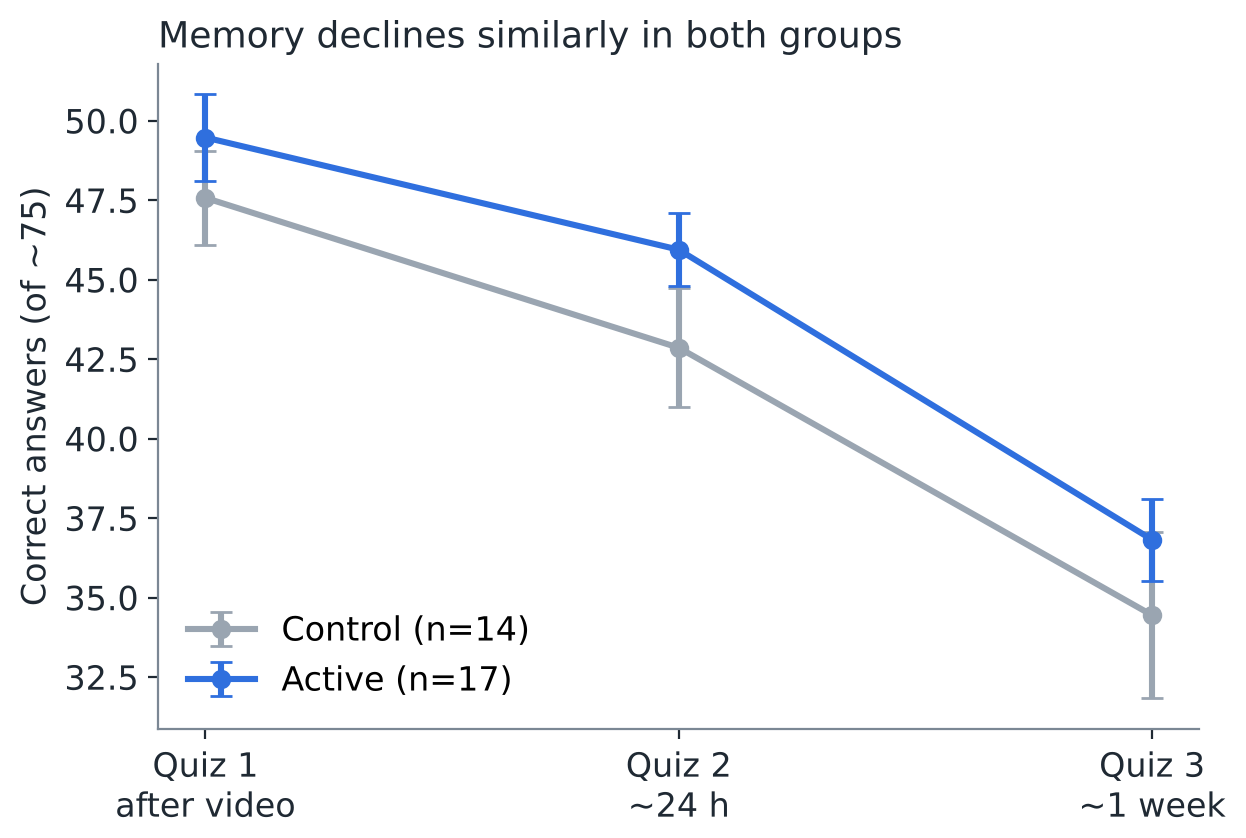
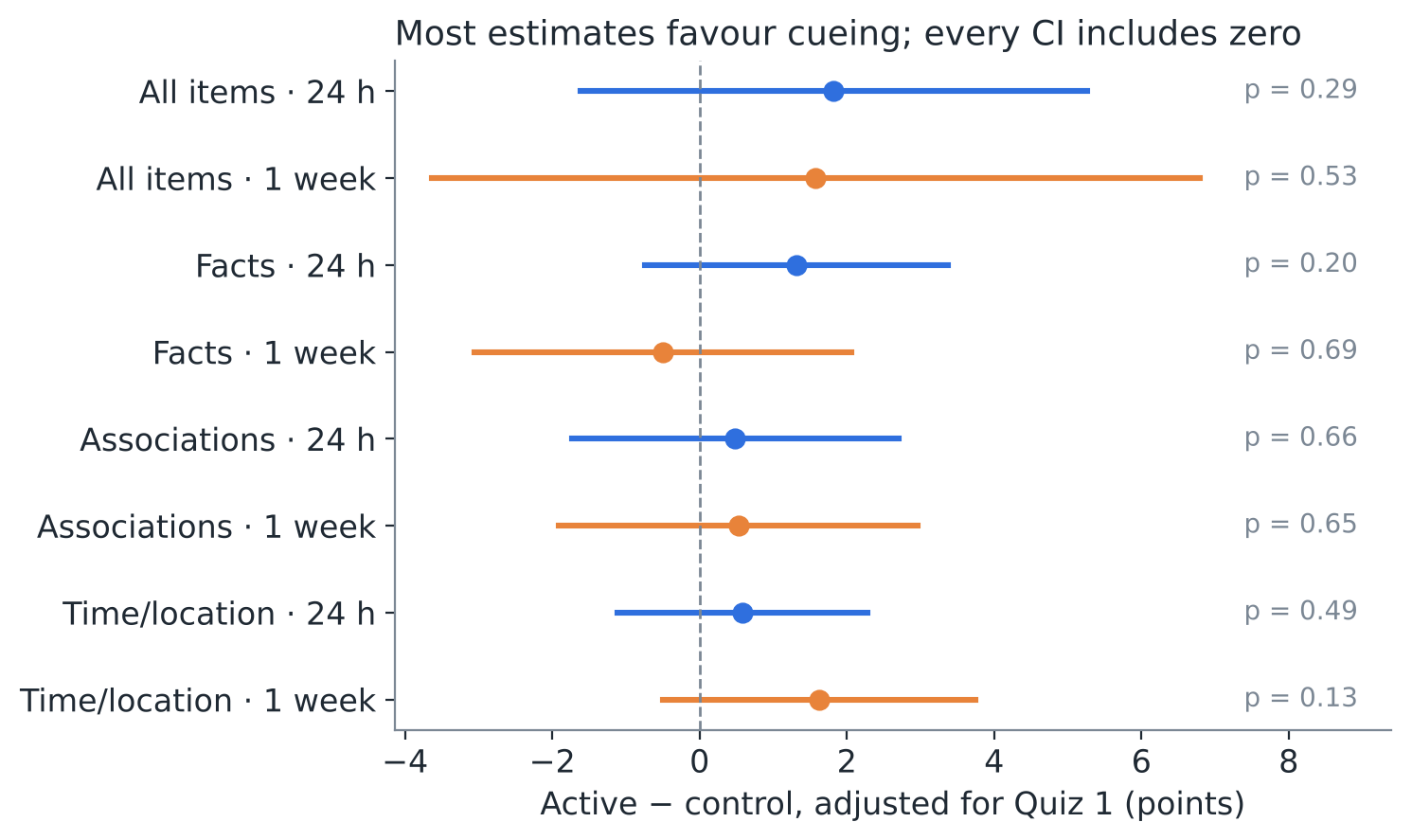
Both groups forgot at about the same rate: roughly 3–5 points overnight and 11–14 points by one week. After adjusting for Quiz 1, the cued group scored about 2 points higher at both 24 hours (p = .29) and one week (p = .53), out of about 75. Every confidence interval included zero, and no question type showed a robust effect.
2. The system worked, and people mostly didn’t notice it
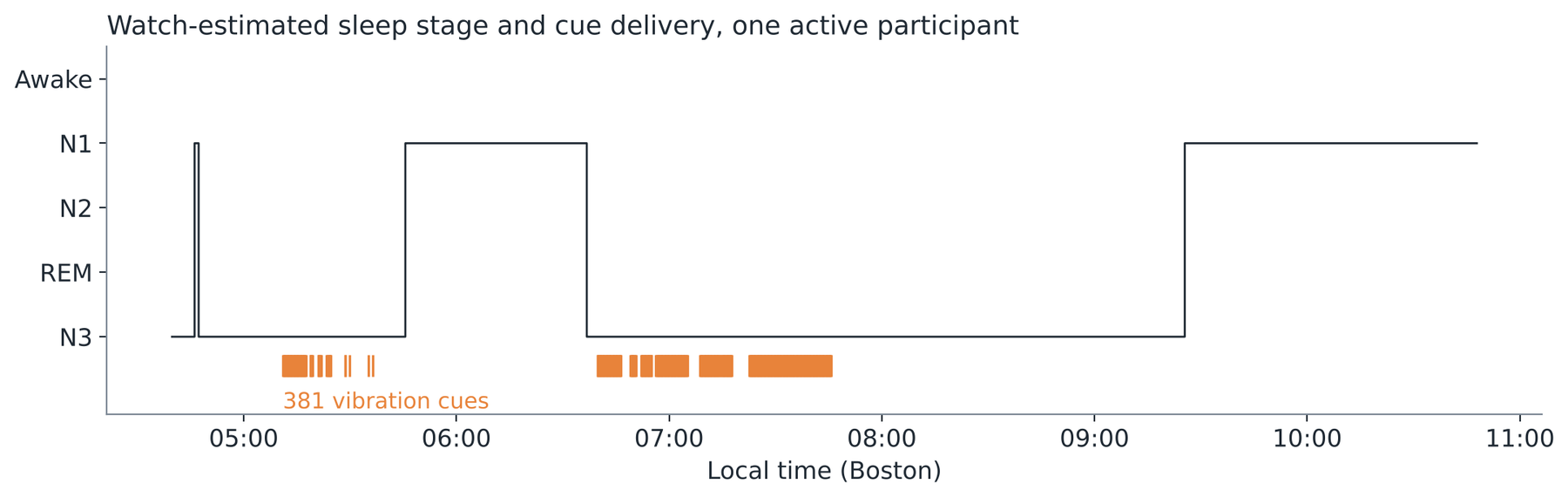
Every logged vibration was delivered during a watch-detected N3 epoch, with a median of 219 cues per active night. Only 3 of 17 cued and 3 of 14 control participants reported noticing vibration at night, so cueing didn’t raise that rate. One caveat: the watch labeled as much as 67% of one night as N3, while healthy adults typically spend 15–25% in N3. The sleep model probably over-detects deep sleep, so some cues likely landed in lighter sleep.
3. Exploratory: more cues, more forgetting
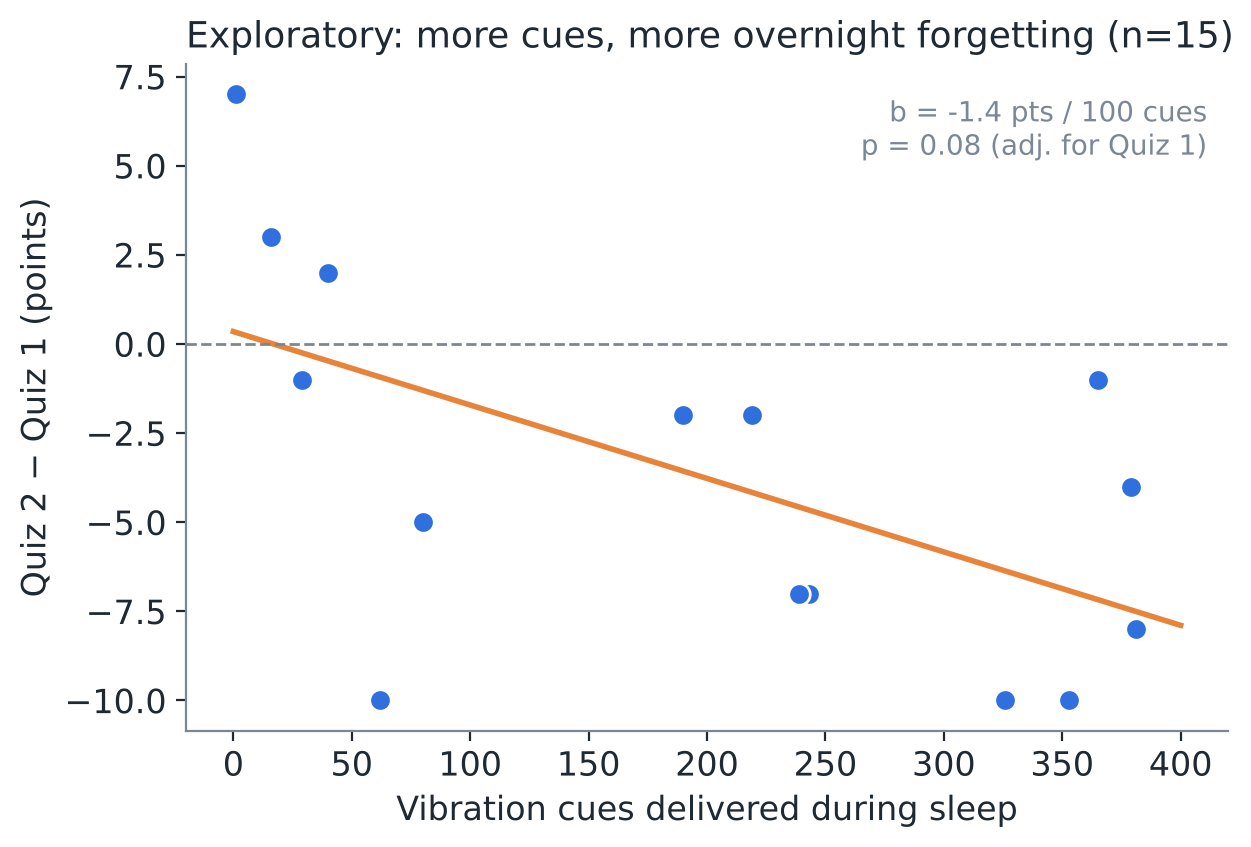
Among cued participants with cue logs (n = 15), those who received more cues forgot more overnight (Spearman ρ = –0.59, p = .02). After adjusting for Quiz 1, the slope was about –1.4 points per 100 cues (p = .08). Heavy cueing may have broken up sleep and cancelled out any benefit. That points to dose control as the next thing to fix: capping cues per night, adapting intensity, and pausing after movement.
My take
Links
BibTeX
@misc{li2025tmrwatch,
  title        = {Can a Smartwatch Strengthen Memory While You Sleep? Vibration-Cued
                  Targeted Memory Reactivation at Home},
  author       = {Li, Chenyi and Whitmore, Nathan W. and Maes, Pattie},
  howpublished = {Unpublished study, Fluid Interfaces Group, MIT Media Lab},
  year         = {2025}
}