The question
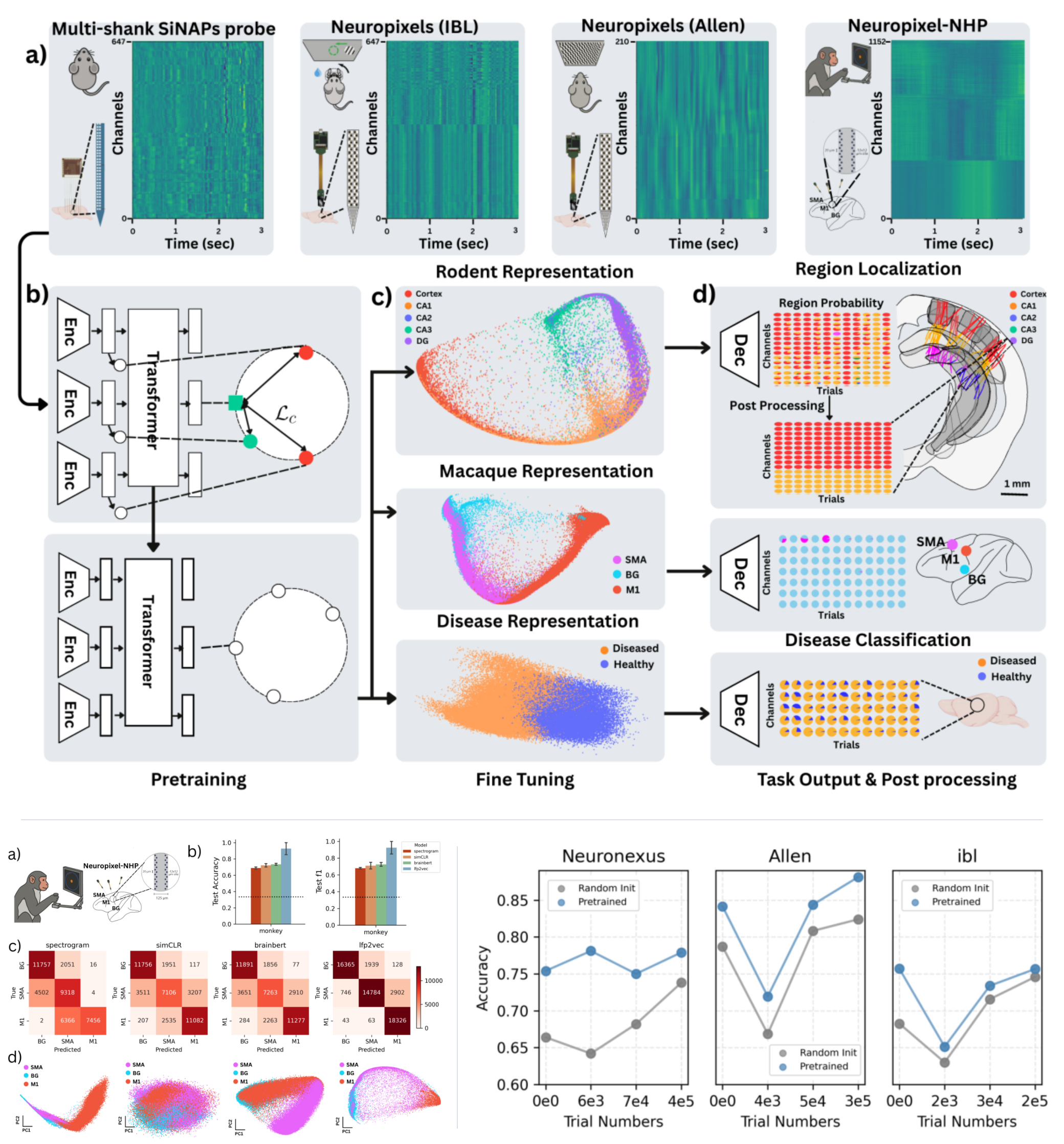
Modern probes record from hundreds or thousands of sites in the brain at once. To interpret the data, you need to know which brain region each site is in. The usual options all have drawbacks. Brain atlases are imprecise because every brain differs. Scans lack fine resolution. Histology only tells you after the experiment, once the animal is gone.
The local field potential (LFP), the slow electrical “hum” every electrode picks up, varies across brain regions. Can a model learn to read an electrode’s location directly from that signal, in a way that works across labs and setups?
What we did
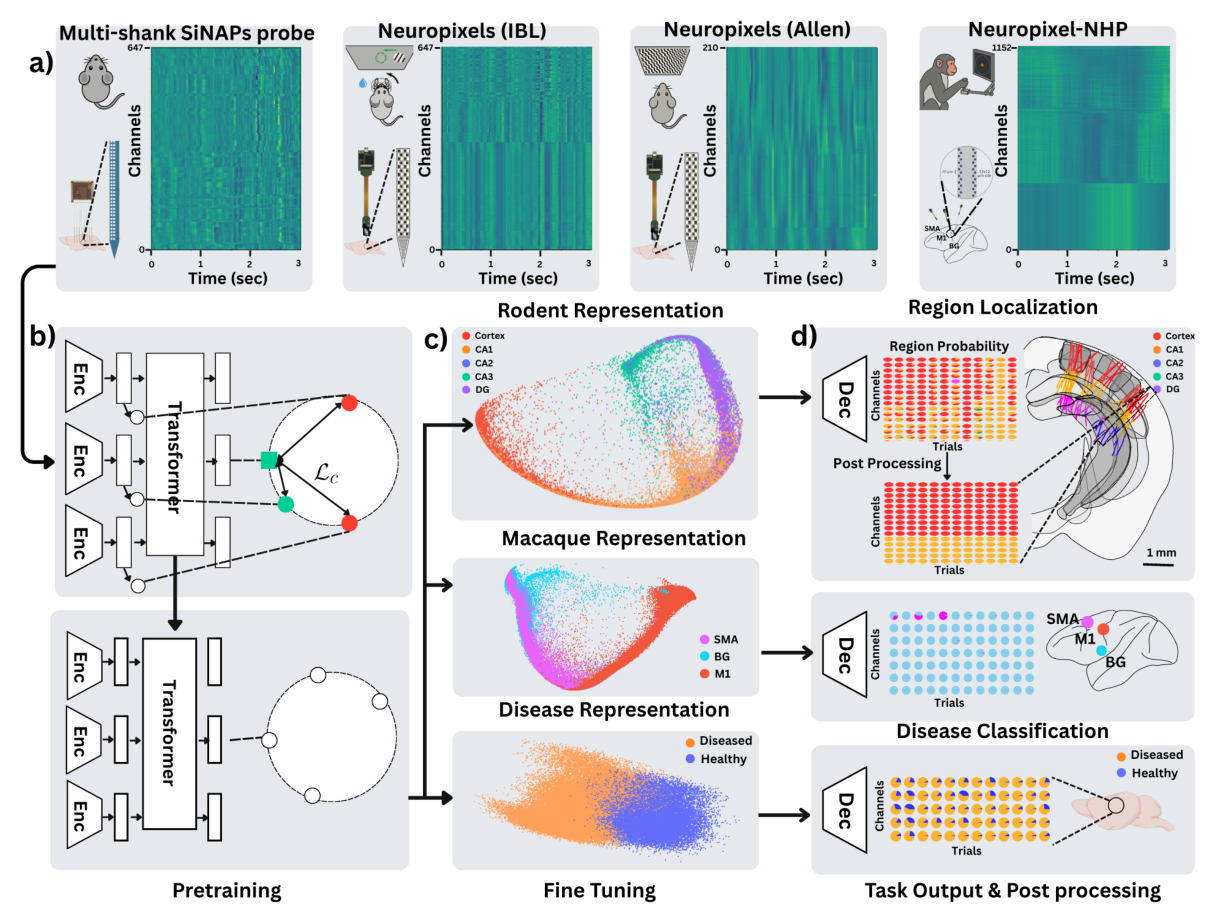
We started from wav2vec 2.0, a model pretrained on human speech audio. We continued training it, without labels, on a large collection of raw LFP recordings, using the same “fill in the masked part” contrastive objective. This step teaches the model what normal LFP looks like. We then added a small decoder and fine-tuned it to predict each channel’s brain region.
We tested on three mouse datasets with different probes and tasks (Neuronexus, Allen Neuropixels, and IBL Neuropixels), on a macaque Neuropixels dataset, and on a mouse model of Alzheimer’s disease.
What we found
1. It finds brain regions better than existing methods
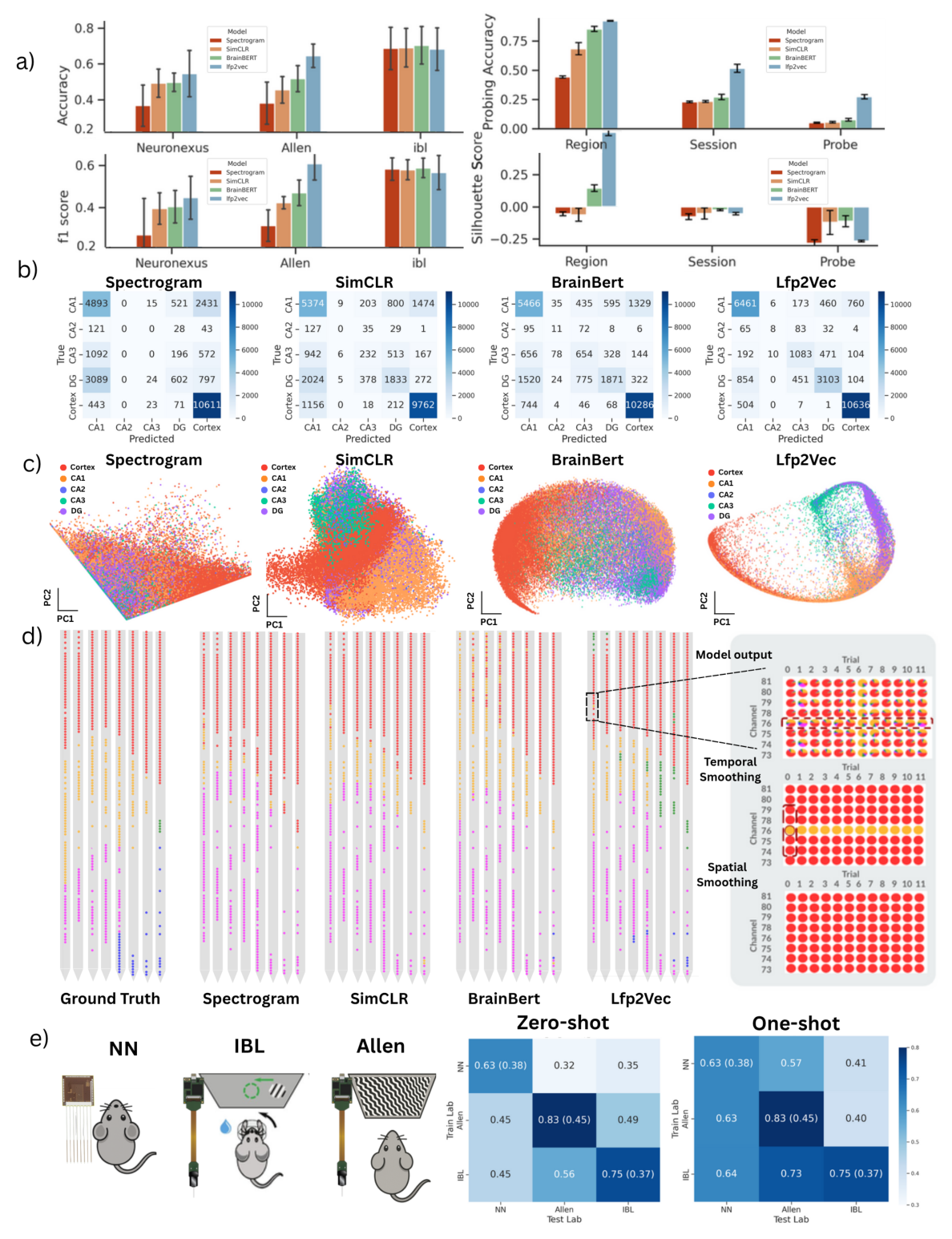
Lfp2vec had the highest balanced accuracy and F1 score on all three mouse datasets. It beat hand-crafted spectrogram features and two other self-supervised models (SimCLR and BrainBERT). Its learned representation separates regions cleanly (silhouette score 0.58, vs. at most 0.15 for the alternatives) without clustering by session or probe.
2. It transfers to new labs, probes, and species
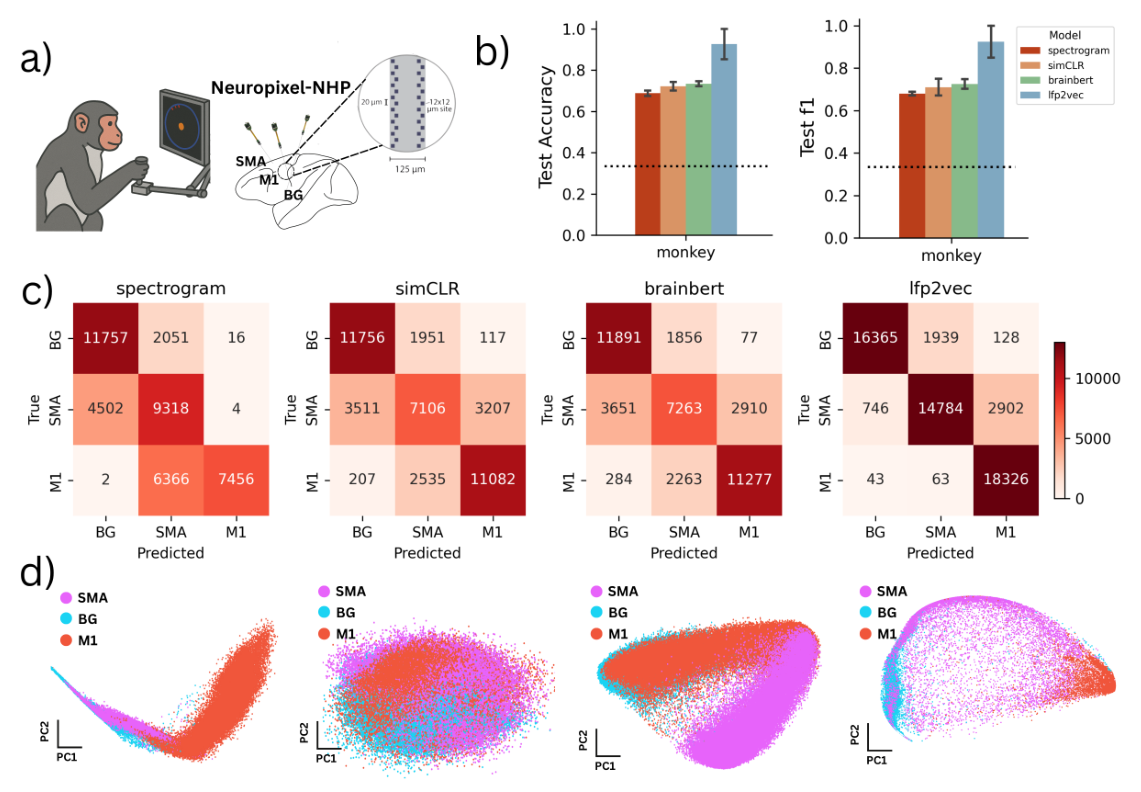
A model fine-tuned on one lab’s data worked zero-shot on another lab’s recordings, especially between the two Neuropixels datasets (Allen and IBL). On macaque recordings it again outperformed the baselines at telling apart motor cortex, supplementary motor area, and basal ganglia.
3. Starting from an audio model helps
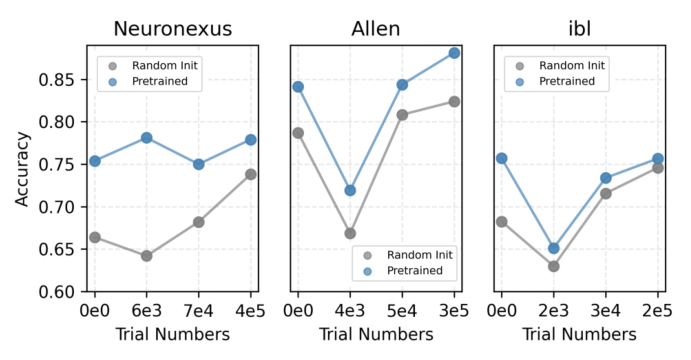
Initializing from a speech model and then pretraining on LFP clearly beat starting from random weights. Patterns learned from sound partly carry over to brain signals. The same representations also distinguished Alzheimer’s-model mice from healthy controls with little extra training.
My take
Links
BibTeX
@inproceedings{he2025lfp2vec,
  title     = {Self-Supervised Learning for In Vivo Localization of Microelectrode Arrays
               Using Raw Local Field Potential},
  author    = {He, Tianxiao and Patel, Malhar and Li, Chenyi and Maslarova, Anna and
               V{\"o}r{\"o}slakos, Mih{\'a}ly and Ramanathan, Nalini and Hung, Wei-Lun and
               Buzs{\'a}ki, Gy{\"o}rgy and Varol, Erdem},
  booktitle = {Advances in Neural Information Processing Systems},
  volume    = {38},
  year      = {2025}
}