The question
EEG measures tiny brain voltages from the scalp, and it is easily swamped by other electrical activity in the body. Blinks and eye movements (EOG) and muscle tension (EMG) can be many times larger than the brain signal itself.
Classic cleaning tools, such as filters, Hilbert–Huang transforms, and ICA, each depend on assumptions about what the noise looks like. They often need an expert to decide which components to throw away. Deep-learning denoisers are more automatic, but they are black boxes. Can we get automatic cleaning whose decisions we can still inspect?
What we did
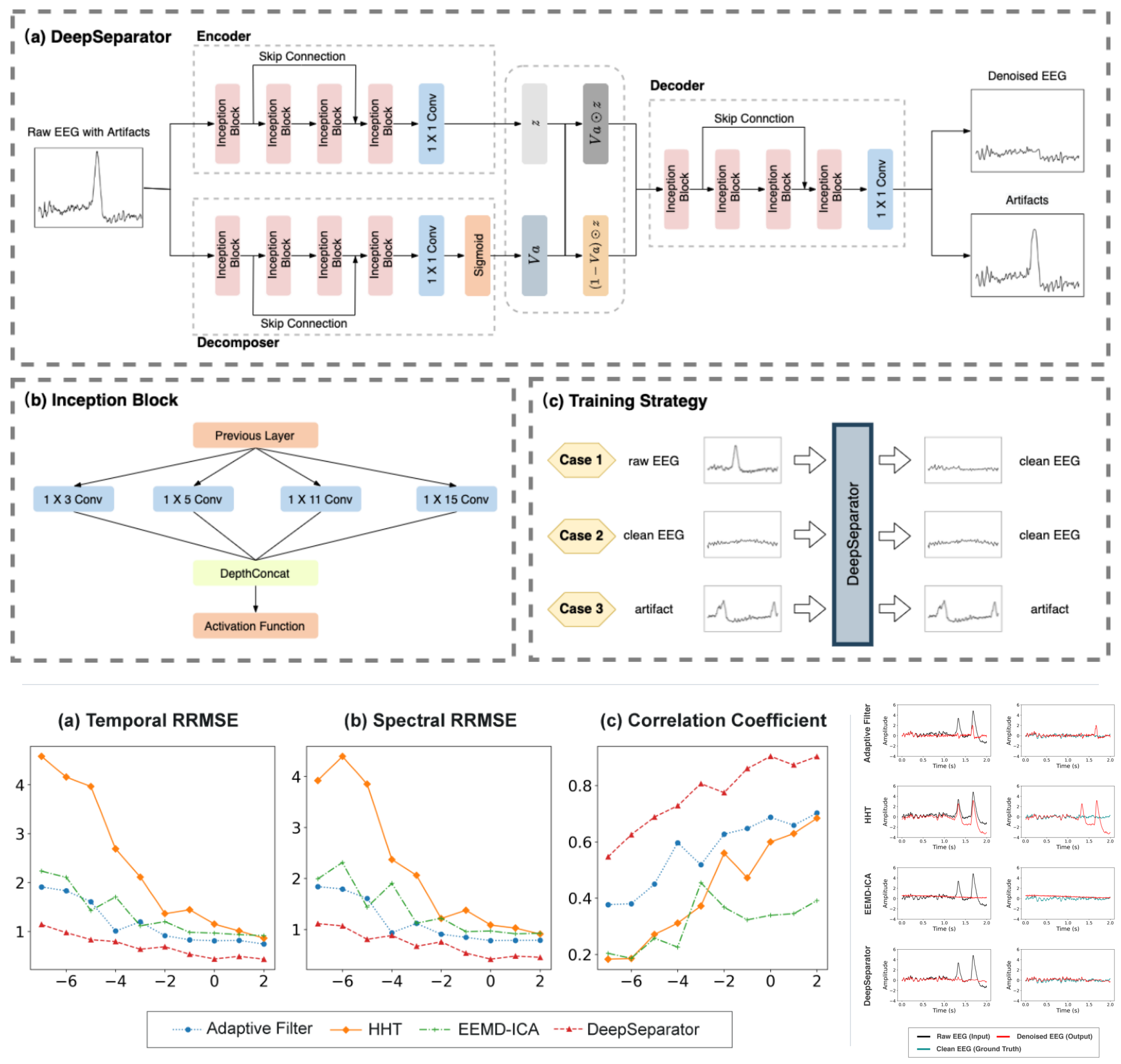
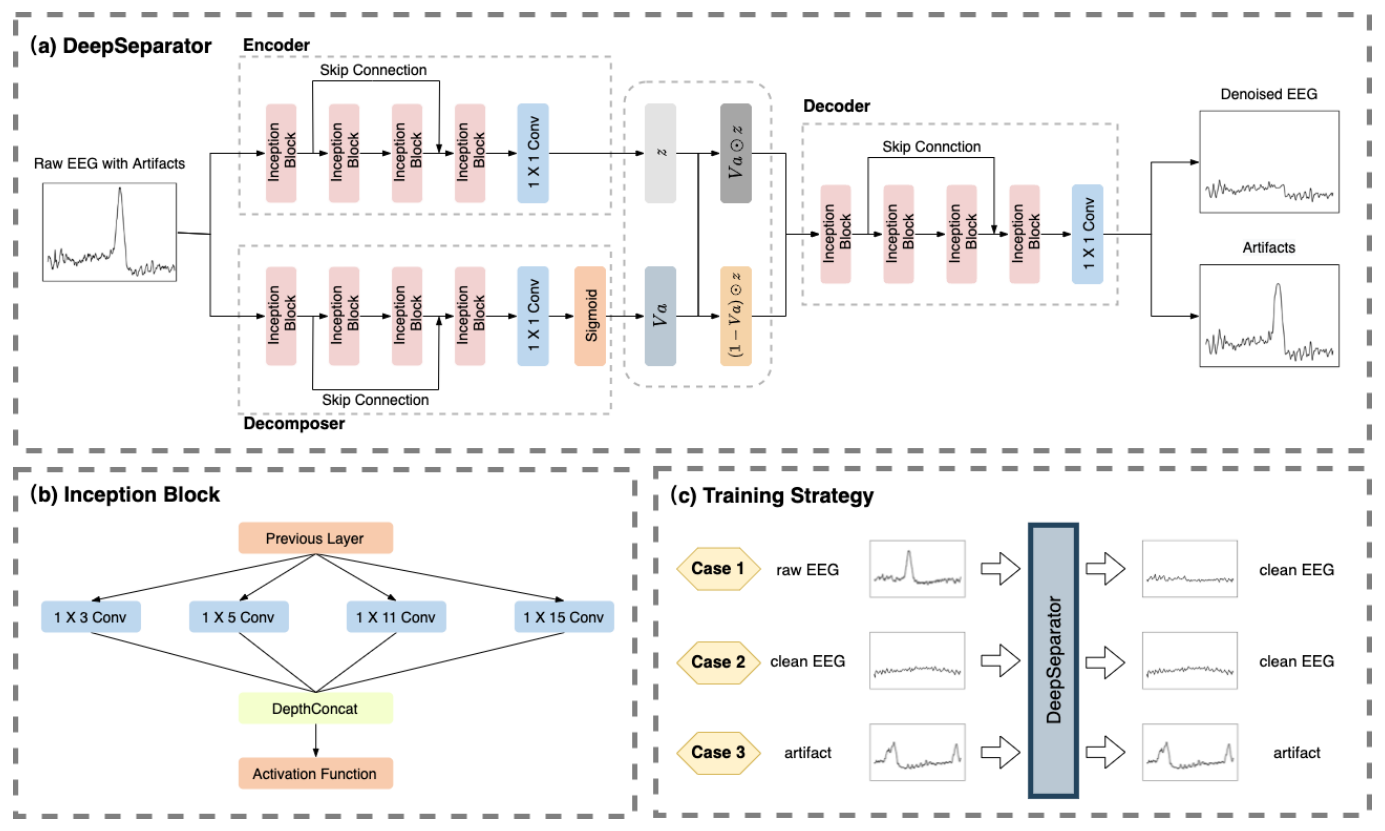
DeepSeparator has three parts:
- An encoder, built from stacked Inception blocks, turns raw EEG into a rich embedding.
- A decomposer learns which parts of that embedding belong to artifacts and turns them down.
- A decoder rebuilds clean EEG from what’s left, and it can also rebuild the artifact that was removed.
We trained it on EEGdenoiseNet, a benchmark that mixes clean EEG with recorded eye and muscle artifacts at known noise levels, so the true clean signal is known. We then applied the trained model to real multi-channel EEG from an auditory experiment.
What we found
1. Lower error than classic methods at every noise level
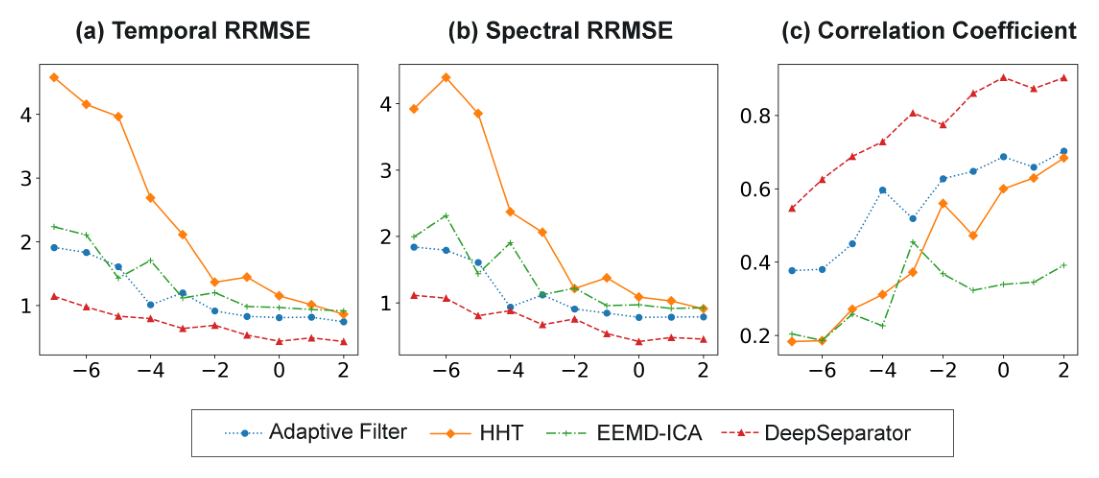
For eye artifacts, DeepSeparator had the lowest error in both time and frequency and the highest correlation with the true clean signal. This held across signal-to-noise ratios from –7 to 2 dB, against adaptive filtering, the Hilbert–Huang transform, and EEMD-ICA. Muscle artifacts showed the same pattern.
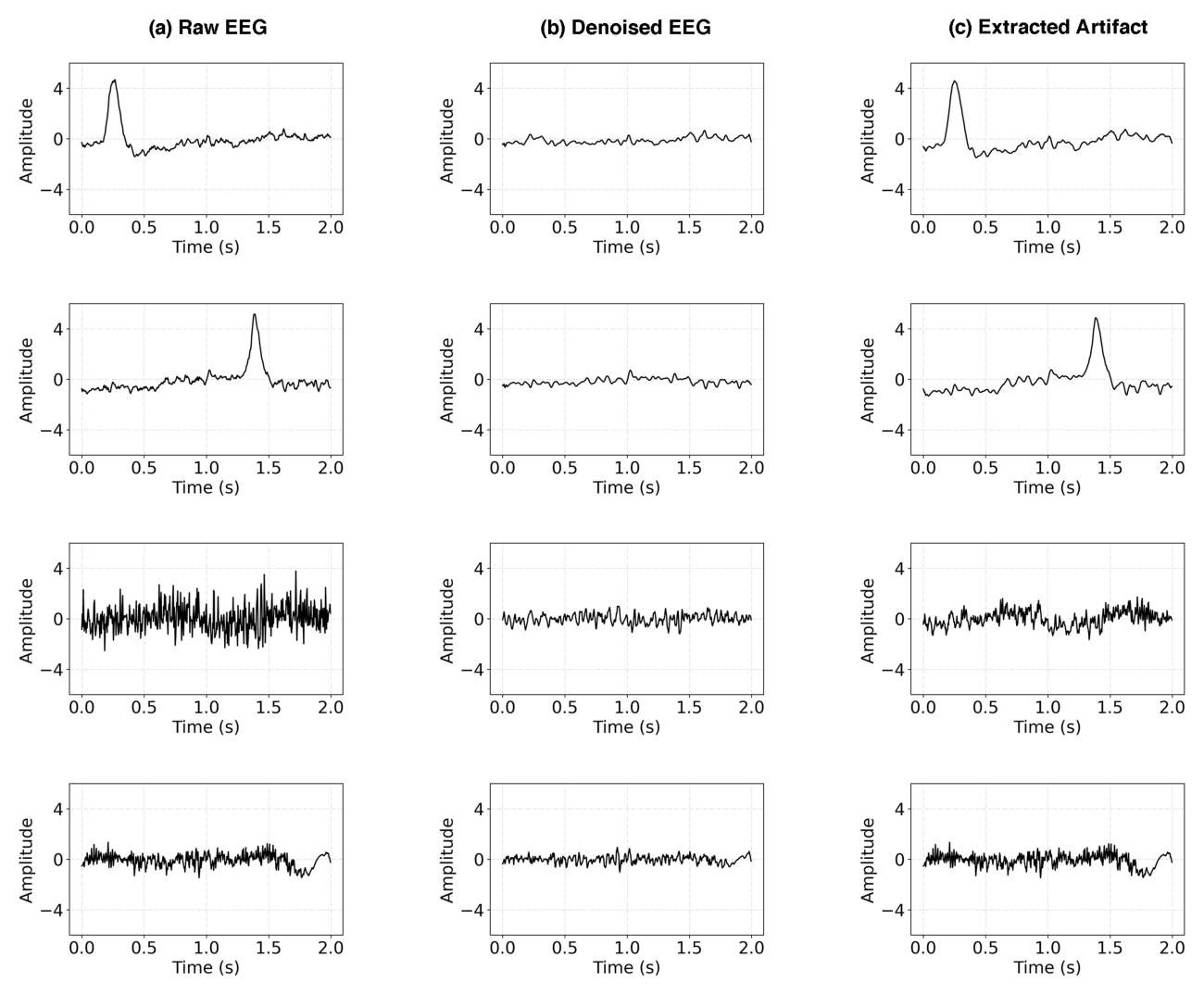
2. It shows you what it removed
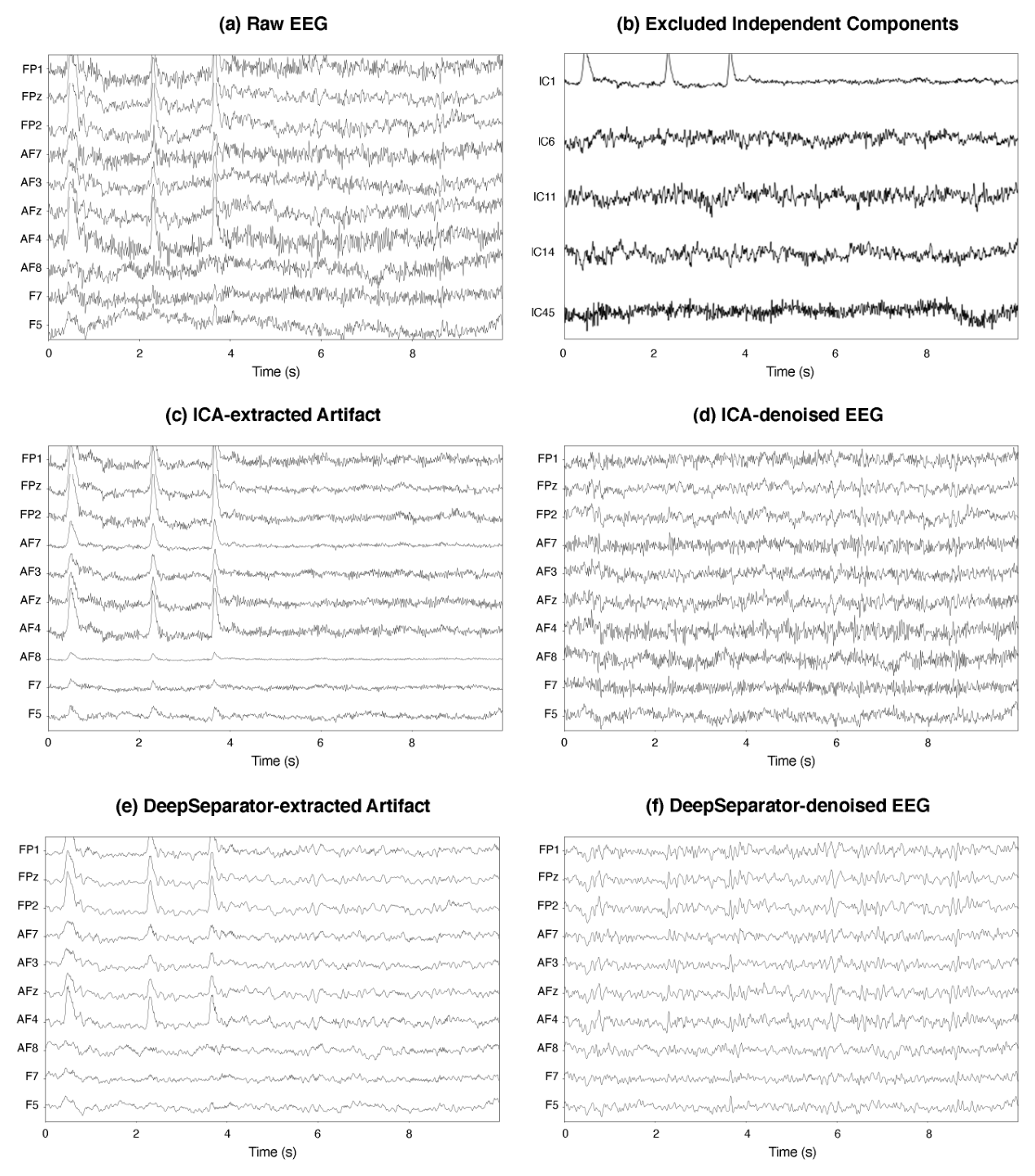
Because the decoder can output the artifact as well as the clean EEG, you can see exactly what was taken out. In practice, the extracted artifacts look like blinks and muscle bursts. This makes the model much easier to trust than a typical black-box denoiser.
3. It works on real, multi-channel recordings
Although it was trained on single-channel, semi-synthetic data, DeepSeparator transferred to real multi-channel EEG. Like ICA, it removed eye artifacts, but without anyone picking components by hand. It also suppressed high-frequency, muscle-like noise. The paper goes on to compare ERPs and source localization after both kinds of cleaning.
My take
Links
BibTeX
@article{yu2022deepseparator,
  title   = {Embedding Decomposition for Artifacts Removal in {EEG} Signals},
  author  = {Yu, Junjie and Li, Chenyi and Lou, Kexin and Wei, Chen and Liu, Quanying},
  journal = {Journal of Neural Engineering},
  volume  = {19},
  number  = {2},
  year    = {2022},
  doi     = {10.1088/1741-2552/ac63eb}
}