The question
Writing is becoming teamwork between people and AI. AI can make a single story more creative, but when many people use the same model, their stories start to sound alike. Researchers call this homogenization. For a whole culture, losing that variety is a real cost.
One fix is to keep humans in the process. But writing has several stages: planning, drafting, reviewing, and revising. At which stage does a human make the most difference?
What we did
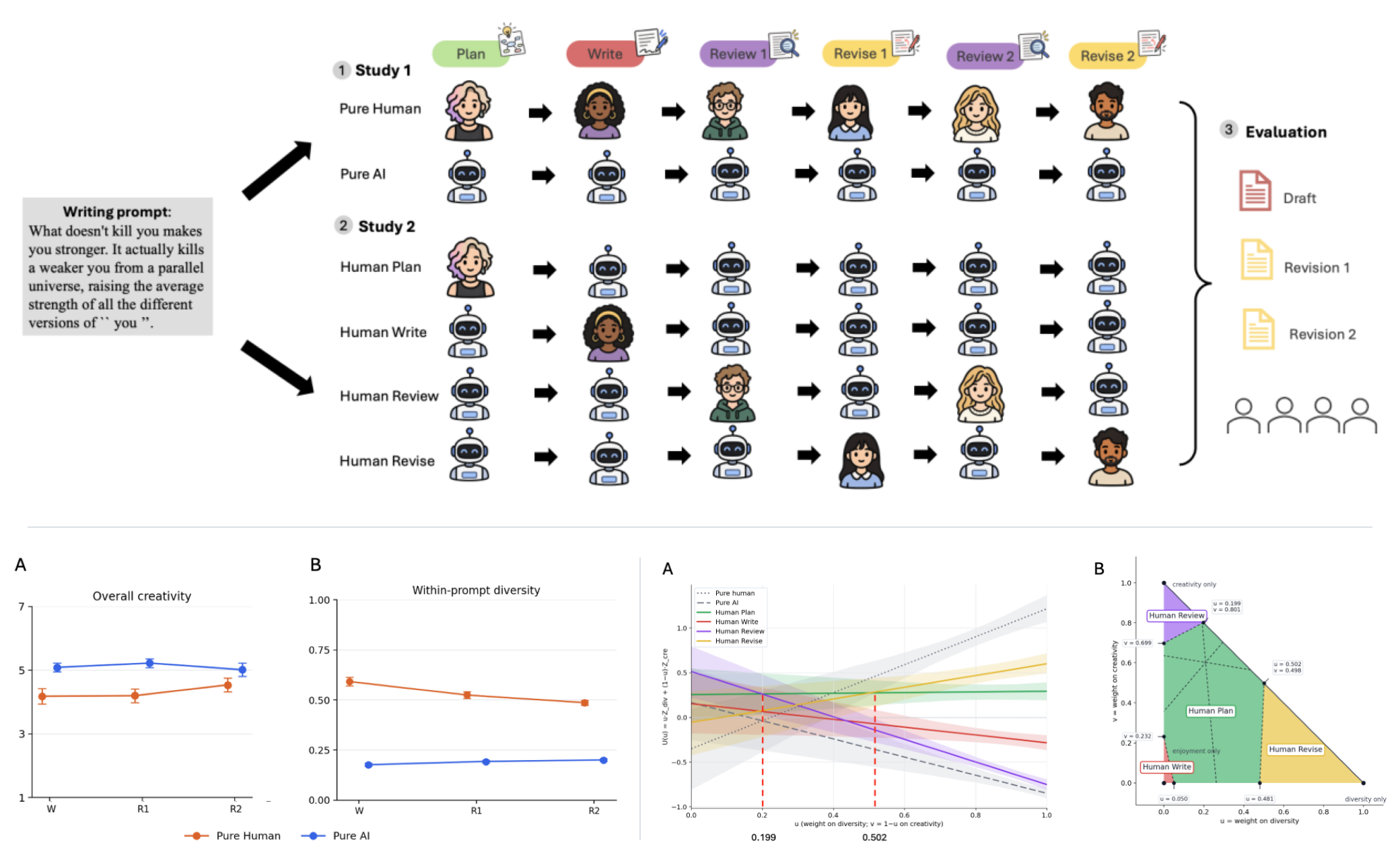
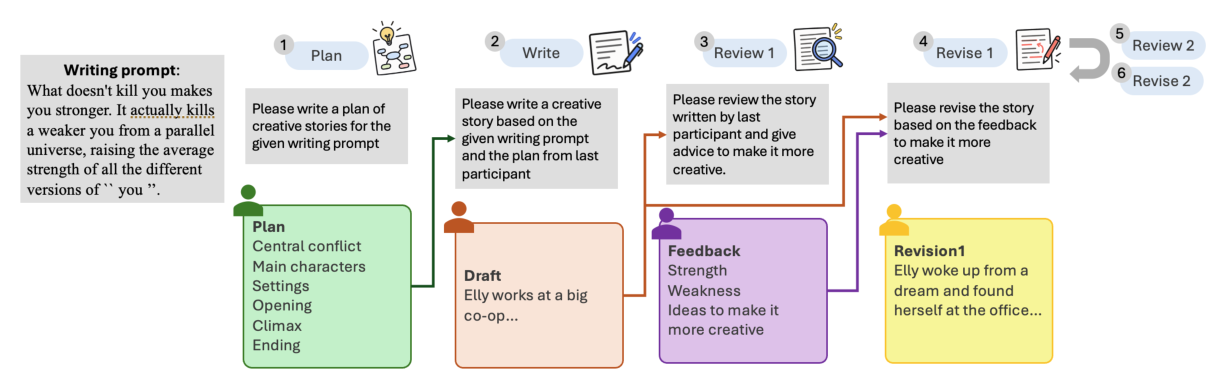
We broke writing into a relay, based on cognitive models of how people write. Each story passes through six stages: Plan → Write → Review → Revise → Review → Revise. Each contributor sees the writing prompt and the previous stage’s output, does their part, and passes the result on.
- Study 1 compared chains done entirely by humans (Pure Human) with chains done entirely by AI (Pure AI).
- Study 2 placed a single human into an otherwise all-AI chain, in one role: Human Plan, Human Write, Human Review, or Human Revise.
Independent human raters scored each story’s creativity. We measured diversity as how different a story is from other stories written for the same prompt. Human contributors also told us how much they enjoyed their role. In total, 333 participants contributed to 427 stories.
What we found
1. All-AI stories are more creative but far less varied
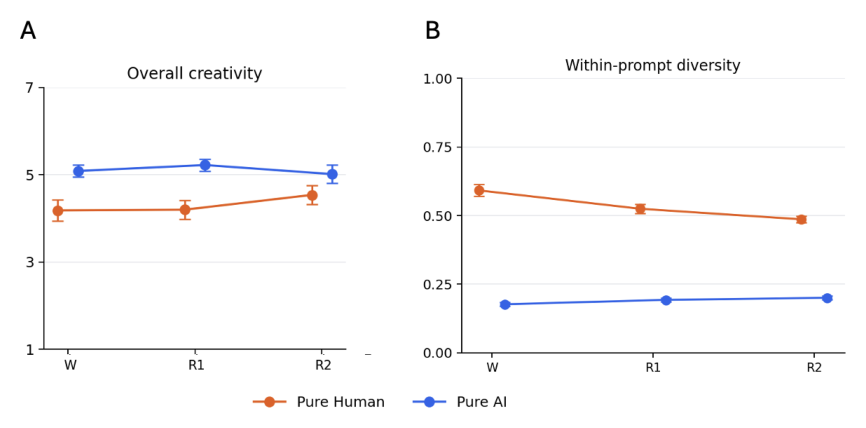
As in earlier work, Pure AI chains got higher creativity ratings than Pure Human chains, but their stories were much more alike. Revision rounds barely changed either pattern.
2. Where the human sits decides how much variety comes back
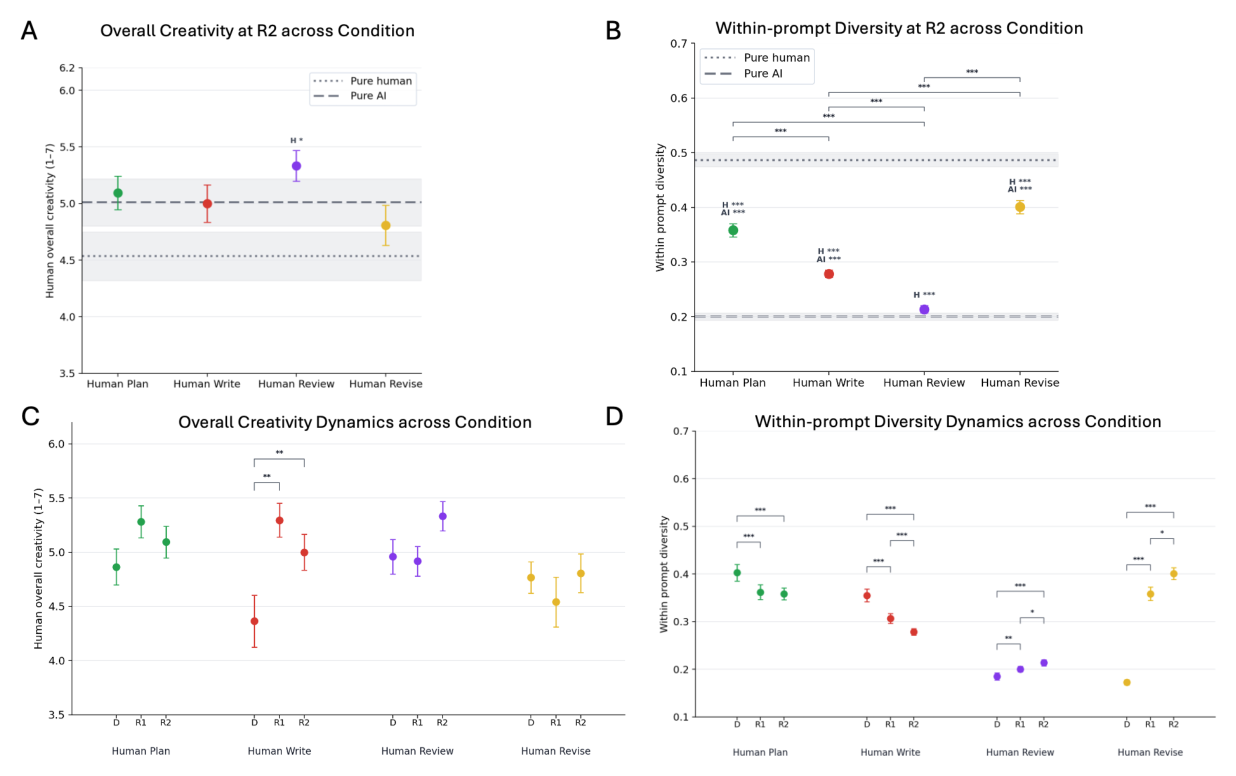
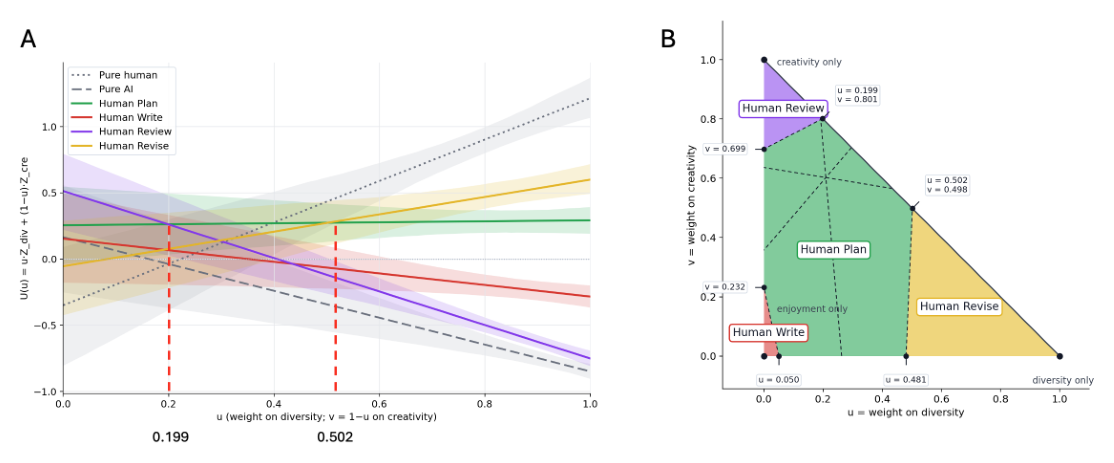
A human who generates content (planning, writing, or revising) made stories significantly more varied than Pure AI (p < .001). A human who only reviewed did not. Human Revise and Human Plan reached the highest diversity. Human Review got the top creativity score, but it had the lowest diversity and the lowest enjoyment. The variety a planner adds also lasts: it survives the AI stages that follow, while variety added at the drafting stage fades round by round.
3. Planning is the best all-round role
We combined creativity, diversity, and enjoyment, weighting them in different ways, and asked which human role comes out on top. Variety enters the chain only through human generation, never through review. Among the generative roles, a human plan balances all three outcomes best. Revising adds variety at the very end, but planning keeps creativity at AI level and its variety holds up downstream.
My take
Links
BibTeX
@article{li2026creativewriting,
  title   = {What Is the Role for Humans in Creative Writing? Creativity and
             Diversity in Human-AI Collaboration},
  author  = {Li, Chenyi and Hu, Haoyu and Marjieh, Raja and Collins, Katherine M. and
             Conley, Dalton and Kreminski, Max and Sucholutsky, Ilia and Jacoby, Nori},
  journal = {arXiv preprint arXiv:2610.37916},
  year    = {2026}
}