The question
New ideas increasingly come from groups that include both people and AI. We know AI can make one person’s work better. But it can also make everyone’s work look the same, and for a group that loss of variety can matter more than any single good idea.
This is hard to study for two reasons. Real creative work is open-ended, so there is rarely a right answer to score against. And people and AI adapt to each other, so you can’t predict how a group behaves by studying one person and one chatbot. We needed a task that is open-ended but still has a clear score, played by real groups.
What we did
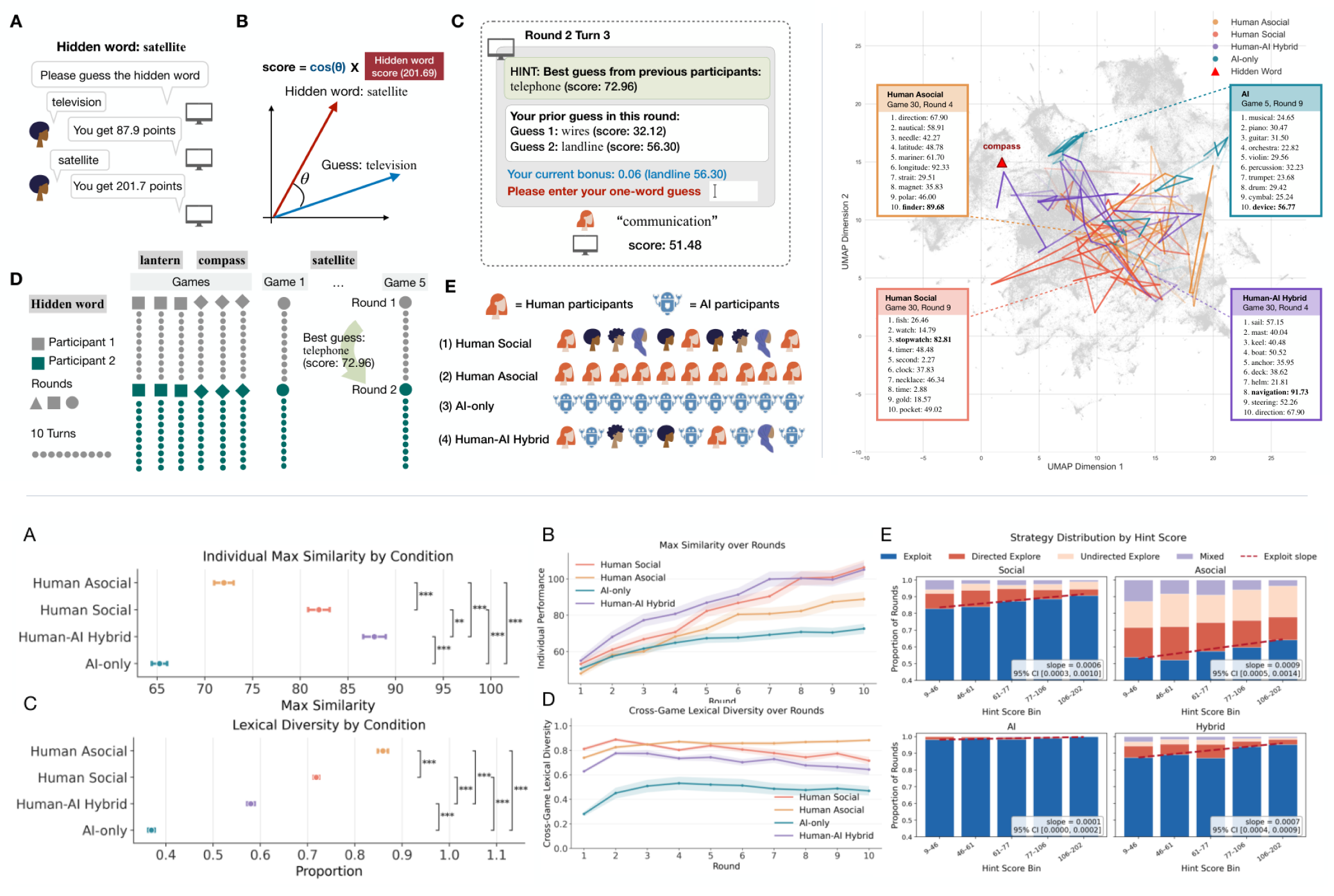
We built a group word-guessing game inspired by Semantle. Each game hides one target word, for example “satellite.” Players type guesses and get a score for how close in meaning each guess is to the target. Closeness is measured with Word2Vec, a model that places words with similar meanings near each other.
A game is a chain of 10 rounds with 10 guesses each. Every new player sees only the best guess found so far, so good ideas are passed down the chain, much as ideas spread through a community. We compared four kinds of groups:
- Human Social: a different person plays each round (210 participants).
- Human Asocial: one person plays all 10 rounds alone (179 participants).
- AI-only: every round is played by Gemini 2.5 Flash.
- Human–AI Hybrid: each round is randomly given to a person or to Gemini (114 participants). Players were not told that some guesses might come from AI.
We used 10 target words and ran 200 games. The experiment was built with PsyNet.
What we found
1. Mixed groups did best, and AI-only groups did worst
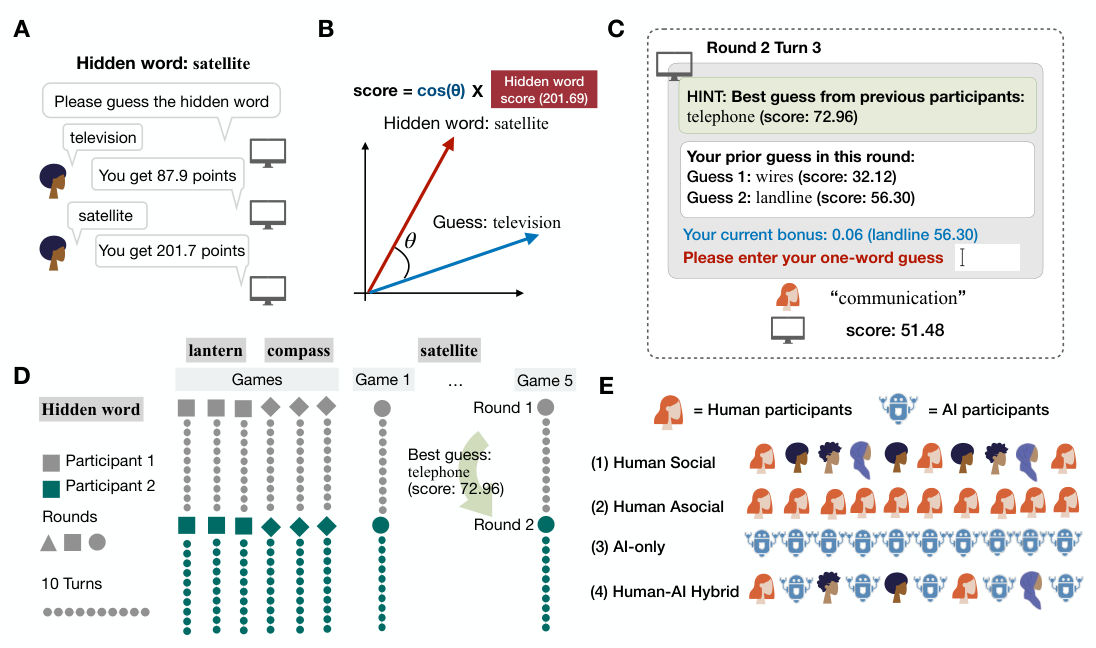
The Human–AI Hybrid groups reached the highest scores (p < .001 against every other group). They also got there fast: by round 3 they were already well ahead of the solo-human and AI-only groups. AI-only groups improved a little at first and then flat-lined after about round 5. AI-only groups also repeated themselves the most, with the lowest share of unique words.
2. AI searches in a narrow area; people roam
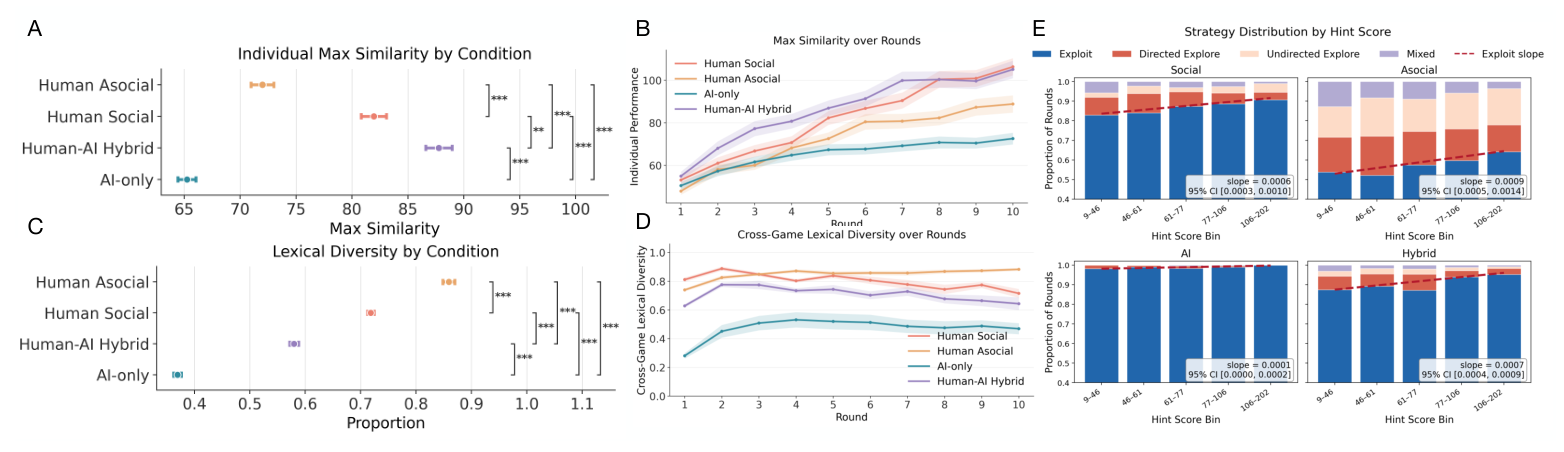
When we plot each group’s path through word-meaning space, the AI-only paths form tight clusters. For the hidden word “compass,” the AI got stuck around musical instruments. Human paths spread out much more widely. Hybrid paths were wide too, but on the whole they ended up closer to the target.
3. Each side changed how the other played
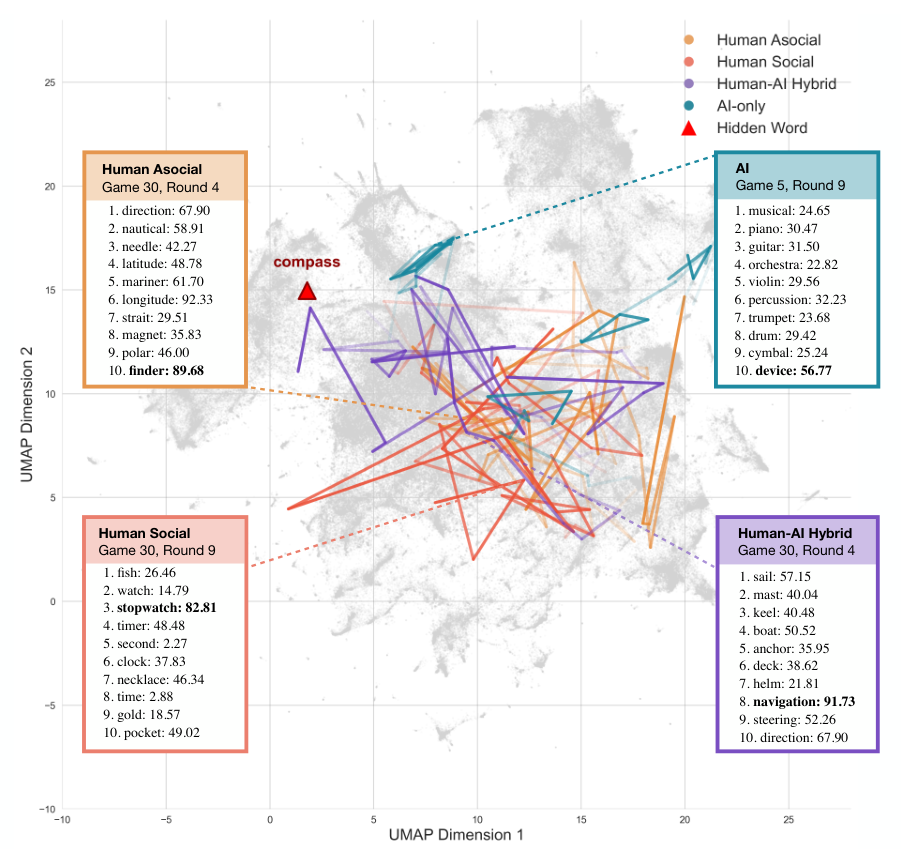
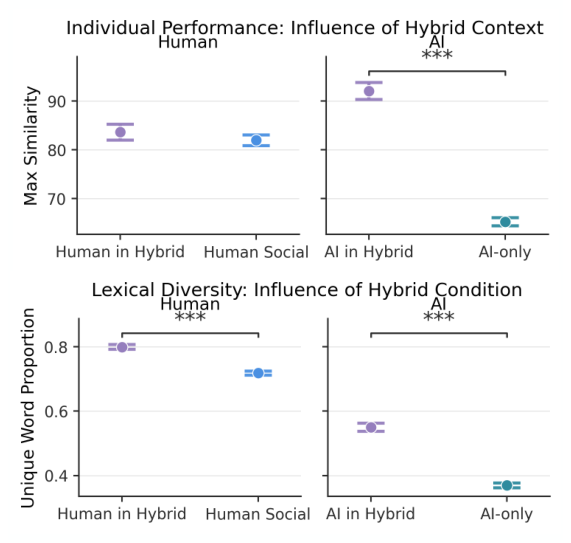
Inside hybrid groups, the AI used more varied words and scored higher than in AI-only groups. People in hybrid groups also made more unique guesses than people in all-human groups. So the gain doesn’t come from just adding people and AI together: each adjusts to the other. We also ran a control in which two different AI models (Gemini and GPT-5.1) played together. That pairing helped somewhat, but still did worse than mixing humans with AI.
My take
Links
BibTeX
@inproceedings{li2026synergy,
  title     = {Human-AI Synergy Supports Collective Creative Search},
  author    = {Li, Chenyi and Marjieh, Raja and Hu, Haoyu and Steyvers, Mark and
               Collins, Katherine M. and Sucholutsky, Ilia and Jacoby, Nori},
  booktitle = {Proceedings of the 48th Annual Meeting of the Cognitive Science Society},
  year      = {2026},
  url       = {https://escholarship.org/uc/item/2pq6f1kw}
}